
Save time
Pre-written, customizable grant content

Writing a successful proteomics grant requires more than strong scientific ideas-it demands clear justification of technology, robust study design, and alignment with funding priorities. We have all the resources you need to build a competitive grant
Pre-written, customizable grant content

Comprehensive, scientific language

Connect with our specialists
High-throughput proteomics enables researchers to analyze thousands of proteins simultaneously, making it a powerful approach for biomarker discovery, disease stratification, and systems biology. Funding agencies increasingly expect proposals to demonstrate scalability, reproducibility, and scientific relevance.
To strengthen your application:
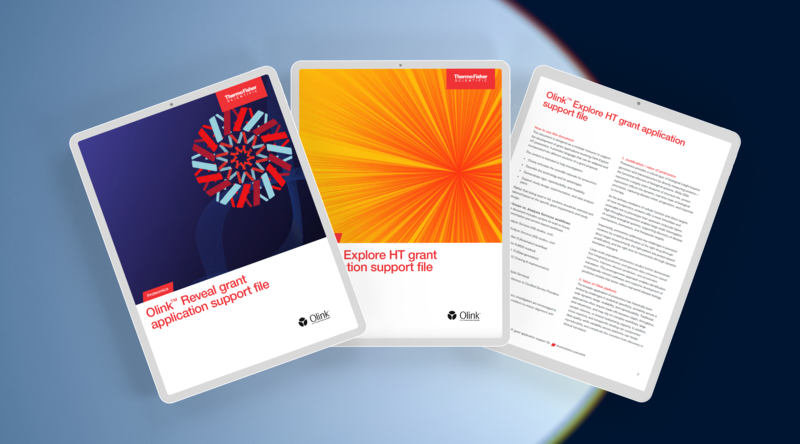
Access ready-to-use grant writing content tailored for proteomics research.
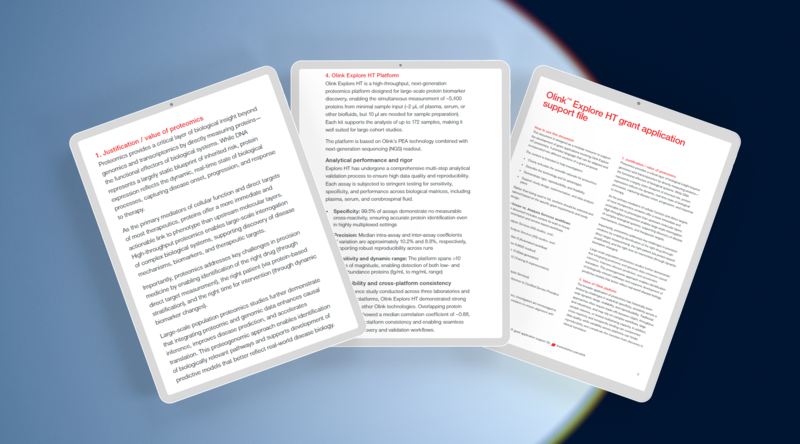
Adapt pre-written sections to fit your study design, funding call, and research objectives.

Connect with Olink specialists for input on study design and technology integration, or request personalized sole-source documentation and Statements of Exclusivity.
Access ready-to-use content designed to accelerate your grant development, including:
| Documents | Type | File |
|---|---|---|
| Olink Explore HT - Grant Application Support | Brochure | |
| Olink Reveal Grant Application Support | Brochure |

Connect with Olink specialists for input on study design and technology integration.
Olink Insight is an interactive, web-based platform that supports study design, biological interpretation, and data contextualization through integrated tools and curated datasets-helping you strengthen the scientitic toundation of your grant application.
Olink Insight
A powerful, free, online bioinformatics app to help translate your research questions into actionable answers.

Explore additional material to strengthen you application
| Documents | Type | File |
|---|---|---|
| Consistency with excellence: lot-to-lot monitoring of Olink® PEA probes technical note | Technical note | |
| Unlock a Bioinformatic Treasure Trove from Groundbreaking Proteomic Data | ||
| Data normalization and standardization | White paper | |
| PEA: Exceptional specificity in a high multiplex format | White paper | |
| PEA- a high-multiplex immunoassay technology with qPCR or NGS readout | White paper | |
| Reliable and reproducible data at any scale with PEA™ | White paper | |
| Design and analytical validation of Olink™ Sample Index | White paper | |
| Olink® Explore HT analytical validation data | Validation method and result | |
| Olink® Explore HT User Manual | Manual & instruction | |
| Olink® Reveal analytical validation methods and results | Validation method and result | |
| Olink® Reveal Overview User Manual | Manual & instruction |
Access on-demand webinars highlighting key applications, study design considerations, and best practices to inform your grant application.
Explore additional material to strengthen you application
A strong proteomics grant should clearly define the biological question, justify the use of high-throughput proteomics, describe study design and cohort selection, and include detailed methodology for data generation and analysis. Reviewers expect clarity on reproducibility, statistical power, and biological relevance.
High-throughput proteomics can be justified by its ability to measure thousands of proteins simultaneously, enabling comprehensive biomarker discovery, pathway analysis, and systems-level insights that are not achievable with targeted approaches.
Proteomics research is supported by major funding bodies including NIH institutes (e.g., NCI, NIAID), Horizon Europe, ERC, UKRI councils, and national research agencies across Europe, North America, and Asia-Pacific.
The methods section should include sample preparation, assay technology, data acquisition, quality control, and statistical analysis plans. Providing validated, reviewer-ready language can significantly strengthen your proposal.
Yes, using well-structured, customizable templates can save time and improve clarity, as long as the content is adapted to your specific research aims and funding requirements.
For Research Use Only. Not for use in diagnostic procedures.