Olink

Olink®
Part of Thermo Fisher Scientific

Why proteomics matters

Beyond cancer genomics: The added value of proteomics

Cancer biology is dynamic, and understanding cancer requires more than identifying genetic alterations. Cancer protein biomarkers provide a functional readout of disease biology, capturing host response, systemic inflammation, and microenvironment interactions that DNA-based methods miss. This broader view supports discovery and can help guide translational and clinical research investigating risk stratification, early detection, treatment selection, and longitudinal monitoring across the cancer continuum.

Insights beyond genes

Complement genomic data with protein measurements reflecting dynamic cancer processes such as immune activity, inflammation, and beyond.

Tumor microenvironment

Explore protein signals involved in cell communication, tissue remodeling, and other critical tumor microenvironment (TME) interactions.

Treatment-associated biology

Investigate protein-level changes associated with therapeutic intervention, response, resistance, or toxicity.

Biomarker patterns

Discover the protein signatures that have the potential to enhance prognostic and predictive models in translational and clinical research programs.

    A better approach
    Combining cancer genomics and proteomics to strengthen oncology biomarker research

    Genomics provides vital information on DNA alterations driving cancer, but proteomics offers a direct window into active biological processes. By combining the insights from both approaches, you can build more complete biomarker strategies for translational and clinical oncology research.

    Genomics only

    Genomics + proteomics

    Captures mutations, copy-number alterations, and other genomic drivers of cancer

    Allows dynamic readouts of immune response, inflammation, and the tumor microenvironment

    Limited in capturing dynamic biological processes such as immune activation, treatment response, and resistance evolution

    Enables measurement of circulating proteins linked to inflammation, immune modulation, and treatment-related toxicity

    Insufficient biomarkers for therapy selection and monitoring in certain modalities

    Identifies potential signatures for prognosis and prediction of response, enriching biomarker discovery and multimodal models

    Limited value for risk prediction and early detection

    Can guide potential strategies for improved risk stratification and early detection

    Key challenges
    Key challenges in oncology research

    While genomic data can identify mutations and other molecular alterations that predict probable cancer outcomes, genomics alone fails to capture the true dynamic nature of this disease. Proteomics adds functional insights to oncology research, but adoption has been historically limited by concerns around workflow complexity, reproducibility, and analytical performance.

    You need tools that support:

    • Functional protein insight beyond genomic alterations
    • Sensitivity across a broad range of protein abundances
    • Reproducible data across studies and sites
    • Compatibility with liquid biopsy
    • Practical integration into translational and clinical research workflows

    Platform benefits

    Advance your oncology research with Olink proteomics

    Olink proteomics helps you bring proteomics into your translational and clinical research with dependable assay performance, scalable workflows, and expert support. From broad discovery to focused follow-up studies, Olink solutions make it easier to generate reproducible data and integrate proteomic insights into existing cancer biomarker research programs.

    Trusted performance

    Olink data is supported by rigorous internal analytical verification and extensive citations in peer-reviewed research, including publications by the UK Biobank Pharma Project.

    Exceptional specificity

    Olink proteomics is built on high-specificity, dual-recognition technology that minimizes cross-reactivity and misleading signals, even at high multiplexing levels.

    Scalable workflows

    Move from exploratory discovery to focused protein analysis with flexible offerings designed for different study sizes and research needs.

    Easier implementation

    Integrate proteomics into your existing cancer genomics workflows with NGS-based readout options, easy-to-use analysis tools, and expert support to guide you.

    Smart sample use

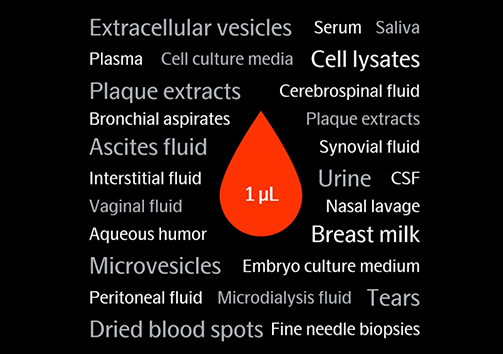
    Measure proteins from low-volume liquid biopsy and other limited oncology research samples without compromising data quality.

    • Unique biomarkers5,400+
    • Targets with minimal cross-reactivity99.5%
    • Sample requirement≥1 µL
    Learning resources
    Featured resources

    Deepen your understanding of proteomics in oncology by exploring our curated resources.

      Resources
      Related documents

      Access key papers, white papers, and technical notes supporting Olink proteomics in oncology research.

      DocumentsTypeFile
      Performance Comparison of Assays Usable for FDA Project Optimus
      White paper
      Proteomics accelerates translational oncology research
      Flyer
      How proteomics enriches early cancer detection
      Technical note
      Advancing biomarker discovery in ovarian cancer with Olink® Explore HT
      Case study
      Download PDF
      Olink® Reveal Chronic Lymphocytic Leukemia Case Study
      Case study
      Cytokine changes in the aged tumor microenvironment in a mouse model
      Case study
      Download PDF
      Insights into immuno-oncology research
      Flyer
      Insights into Th cytokine profiling in disease research
      Flyer
      Insights into the predictive value of blood IFN signature in cancer
      Flyer

      Olink Explore HT

      Measure 5,400+ proteins with proven specificity to gain an understanding of disease at the protein level.

      Proteins

      5,400+ With proven specificity

      Sample

      2 µL Plasma, serum & more

      Olink Reveal

      Accessible NGS-based proteomics for every lab. Unplugged from complexity, powered by insights

      Proteins

      >1,000 Powerful. Simple. Accessible

      Sample

      4 µL Plasma, serum & more

      Olink Target 96 icon.

      Olink Target 96

      Target specific disease areas or key biological processes with multiplex immunoassay panels.

      Proteins

      92 11 targeted panels

      Sample

      1 µL Plasma, serum & more

      Olink Target 48

      Extensively validated and carefully selected biomarkers for a comprehensive view of immune and neurodegeneration processes.

      Proteins

      up to 45 3 panels

      Sample

      1 µL Plasma, serum & more

      Access options
      Bringing PEA technology into your research

      Whether you are looking for full-service sample analysis, support from a Certified Service Provider, or want to run the assays in your own lab, you can access Olink solutions in a way that fits your study designs and infrastructure needs.