Olink

Olink®
Part of Thermo Fisher Scientific

Why proteomics matters

Why proteomics matters for drug development decisions

Drug development risks often stem from biological uncertainty. Protein biomarkers provide a functional readout of biology underlying disease and drug response. By measuring this dynamic view of diseases, proteomics accelerates target discovery, potential patient stratification strategies, pharmacodynamic monitoring, and drug repurposing.

Target identification

Identify proteins that may be causal for disease to find promising drug targets.

Population selection and enrichment

Define proteomic signatures with the potential to guide stratification of sample cohorts and enable smaller studies.

Pharmacodynamics

Confirm pathway modulation, mechanism of action (MOA), and safety-linked biology before major clinical investment.

Non-invasive biomarkers

Detect biomarkers in accessible fluids, reducing reliance on invasive tissue biopsies.

Drug repurpose

Discover new indications and rescue assets by identifying previously unrecognized biological pathways and MOAs

    Unlock proteomics for drug discovery

    Download our eBook to learn how proteomic biomarkers can accelerate drug discovery and development, reducing risks from target identification to clinical trial research.

    Comparison
    How Olink proteomics supports drug discovery and development

    Olink solutions help pharma and biotech research teams generate high-quality protein biomarker evidence across all stages of the drug development pipeline. With high-specificity technology, scalable discovery-to-focused panel options, and expert support, you can investigate disease biology, population heterogeneity, treatment-associated biology, and safety signals with greater confidence.
    Olink proteomics-enabled approach

    Traditional approach

    Target discovery

    Discovers high-specificity proteomic signatures to identify causal biology and support relevant target hypotheses

    Often limited to genomics or transcriptomics insights only, which don’t always translate directly to dynamic disease states

    Cohort strategies

    Can discover proteomic signatures associated with likely responders, helping reduce study size

    Typically use broad clinical research criteria for guiding enrollment

    Mode of action

    Measure on- and off-target protein changes to characterize drug mechanisms

    Rely on limited biomarkers to infer mode of action

    Longitudinal research

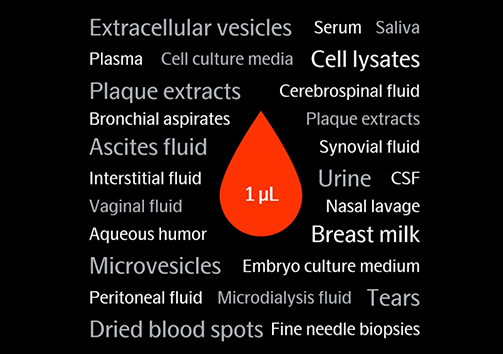
    Support longitudinal studies in accessible, non-invasive biopsies and small sample volume requirements, as little as 1 µL

    Use invasive biopsies and/or expensive imaging that limit sample collection

    Repurposing

    Allows systematic identification of new indications through large-scale proteomic profiling of thousands of targets

    Often depends on opportunistic discoveries or limited cross-disease biological evidence

    Asset lifecycle

    Support decisions across the asset lifecycle

    Olink solutions can help you generate protein data to answer the critical questions that drive asset decisions in all stages of drug discovery and development.

    Target discovery and prioritization

    Link proteins, genetics, and disease biology to move from association toward causal, relevant target hypotheses.

    Translational and early clinical research

    Use human research samples to evaluate pathway modulation, pharmacodynamic response and safety-linked biology earlier.

    Clinical research trial design and execution

    Discover protein signatures that may support cohort enrichment, endpoint refinement, and monitor response or safety-linked biology.

    Late phase and lifecycle management

    Move discovery signatures into focused research panels and use reverse translation to explore lifecycle opportunities.

    Use cases
    Explore proteomic applications in pharma research

    Dive deeper into how Olink proteomics accelerates key applications in the drug development process, from early target discovery to translational and clinical trial research.

    Expert perspective
    Expert perspective: Population-scale proteomics for target discovery

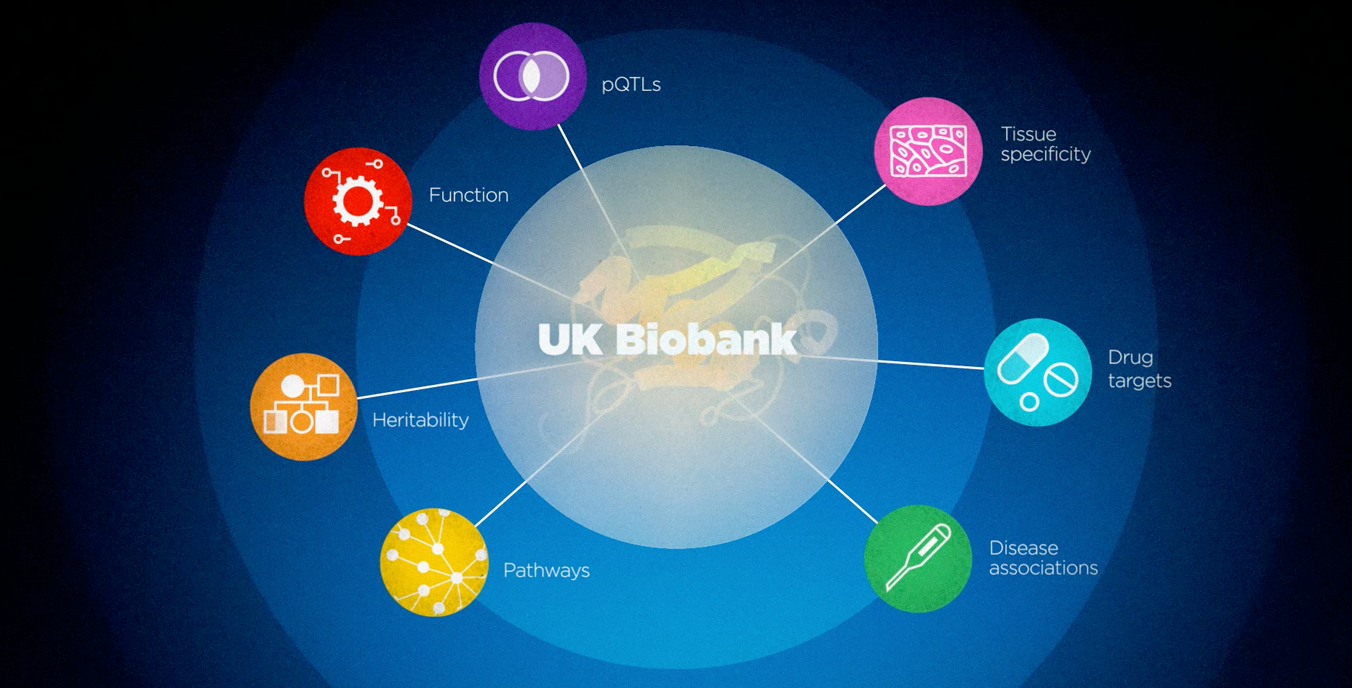
    Dr. Chris Whelan, former Chair and Principal Investigator of the UK Biobank Pharma Proteomics Project (UKB-PPP), discusses how the UKB-PPP pilot is profiling ~50,000 samples with Olink Explore to connect genetic variation and protein levels, enabling the identification of causal disease biomarkers and higher-confidence drug targets.

    Learning resources
    Resources for proteomics-enabled drug development

    Explore resources showing how you can integrate Olink proteomics into your drug development program.

    Expert perspective
    Advancing disease understanding and therapy development

    Dr. Ryan Dhindsa, PhD, Professor at Baylor College of Medicine, discusses leveraging phenome-wide association studies, exome-wide association studies), and collapsing analysis to aid in the identification of new therapeutic targets and potential clinical biomarkers.

    Testimonials

    Voices of our customers

    Real perspectives from researchers using Olink solutions to improve biomarker discovery, translational research, and proteomics analysis.

    "We start by understanding the disease we want to treat as that defines everything else. Proteomics is just giving us a lot more in terms of identifying biomarkers that are really relevant to our processes."

    Dawn Waterworth

    PhD – Executive Director, Immunology Translational Sciences, Johnson & Johnson Innovative Medicine, with extensive expertise in multiomics.

    “Traditionally, biomarker discovery was limited to analyzing one marker at a time, which constrained exploratory work and narrowed our view of disease biology. but with the advent of high-throughput proteomic platforms—capable of measuring thousands of proteins from just a small sample volume—we’ve unlocked the ability to explore the proteome at scale. this shift has opened the door to discovering novel, biologically relevant drug targets that were previously out of reach.”

    Magnus Althage

    PhD Head of Translational Science Strategy, AstraZeneca R&D, specializing in human target alidation, patient identification, and biomarker strategy.

    “We often hear about data-driven decision-making, but it’s not just about having data—it’s about the quality of the data and distilling that data into actionable insight. As multiomics technologies, like Proteomics, evolve generating massive amounts of information, the real value lies in translating those signals into knowledge that can guide smarter decisions.”

    Jen-Chieh (Jay) Chuang

    PhD Director, Translational Biomarker Lead at Takeda Pharmaceuticals

    “Proteomics is rapidly emerging as an innovative approach to gaining potential insights into the mechanisms of disease and drug action.”

    Zannad F

      Research highlights
      Selected reading in drug development

      Explore case studies and articles showing how Olink solutions accelerate drug discovery, facilitate every stage of drug development, and help reduce pipeline risks.