Olink

Olink®
Part of Thermo Fisher Scientific

  • Technical
Intro
Your questions about the Olink proteomics platform, answered

Olink proteomics uses Proximity Extension Assay (PEA) technology to measure hundreds to thousands of proteins from low-volume samples. It combines dual-antibody protein recognition with DNA-based quantification using qPCR or NGS. This FAQ page explains how the platform works, its applications and sample types, and how it differs from other proteomics approaches.

Proteomics is reshaping what’s possible in disease research by helping researchers better understand disease biology, identify biomarkers, and support drug development. Because proteins are the functional molecules carrying out cellular processes, high-quality proteomic data can provide insights that genomics alone may miss.

However, the value of any proteomics study depends on the quality of the underlying data. To generate clinically meaningful findings, researchers need reliable results that can be reproduced and scaled across multi-site studies.

Choosing the wrong platform early can lead to wasted samples, delayed timelines, and results that are difficult to validate. Among the available technologies, Olink proteomics platform has emerged as a widely adopted solution for sensitive, high-throughput protein analysis.

This FAQ page answers common questions about Olink proteomics, including how our Proximity Extension Assay (PEA™) technology works, common use cases for the Olink platform, and how it compares to other proteomics approaches.

Question 1
What is Olink proteomics?

Olink proteomics is a protein analysis platform that uses Proximity Extension Assay (PEA) technology for multiplex protein measurement. It enables the simultaneous measurement of tens to thousands of proteins, depending on the assay and platform, and is used in research applications including biomarker discovery, drug development research, clinical and translational research, and large-scale population studies.

Question 2
What is PEA technology?

Proximity Extension Assay (PEA) technology is a dual-antibody-based method for protein detection.

Question 3
How does Olink proteomics work?

Olink proteomics combines antibody-based protein detection with DNA-based quantification.

Proteins are first recognized by antibody pairs using PEA. The resulting DNA signal is then quantified using qPCR or next-generation sequencing (NGS), enabling scalable and multiplex protein analysis across large sample sets.

Question 4
When should I use Olink proteomics?

Olink proteomics can be used when multiplex, high-throughput and reproducible protein measurement is required, particularly when sample volume is limited, or large sample sets need to be analyzed.

Typical use cases include biomarker discovery studies, large cohort or population studies, longitudinal studies, and applications in drug development and clinical research.

Question 5
What research applications use Olink proteomics?

Olink proteomics is used in research applications including biomarker discovery and analytical validation, drug development, clinical and translational research, longitudinal studies, and large cohort or population-scale studies. Olink-based research spans disease areas including cardiovascular-kidney-metabolic diseases, oncology, neurology, immunological and inflammatory conditions, and infectious diseases.

Question 6
Can Olink proteomics be used for biomarker discovery?

Yes. Olink proteomics is used for biomarker discovery and verification.

Its ability to measure thousands of proteins simultaneously makes it well suited for identifying novel biomarkers and understanding disease mechanisms.

Question 7
Is Olink proteomics suitable for clinical and translational research?

Yes. Olink proteomics is used in clinical and translational research.

It supports investigations into potential strategies for patient stratification and disease monitoring in addition to biomarker validation, especially in studies requiring high reproducibility.

Question 8
Is Olink proteomics used in large cohorts and population-scale studies?

Yes. Olink proteomics is used in large cohort and population-scale studies.

Its scalability and reproducibility make it suitable for analyzing thousands of samples in longitudinal and multi-site research.

Learn more about population-scale proteogenomics studies using the Olink platform.

Question 9

What sample types Olink proteomics supports?

Olink panels are validated for human plasma and serum samples.
A range of additional sample types are compatible with Olink technology, including:

Citrate plasma

Heparin plasma

Tissue and cell lysates

Fine needle biopsies

Micro-dialysis fluid

Micro-dialysis fluid

Dried blood spots

Synovial fluid

Cerebrospinal fluid

Plaque extract

Saliva

Extracellular vesicles

    Question 10

    Which Olink solution fits different study scales?

    The right Olink solution depends on factors such as the number of proteins you want to measure, sample availability, cohort size, and study objectives. For smaller or more targeted investigations, Olink Flex and Olink Target panels provide focused protein measurement options, while higher-plex solutions like Olink Reveal can support studies requiring broader protein coverage and greater scale.

    Explore validated assays for your study with the Olink Biomarker Search tool.

    Question 11
    What studies have Olink solutions used?

    Olink solutions have been used in studies across multiple disease areas, including Cardiovascular-kidney-metabolic (CKM) diseases, oncology, neurology, immunological & inflammatory conditions, and infectious diseases. Examples include large population-scale and multi-cohort proteomics and proteogenomics studies.

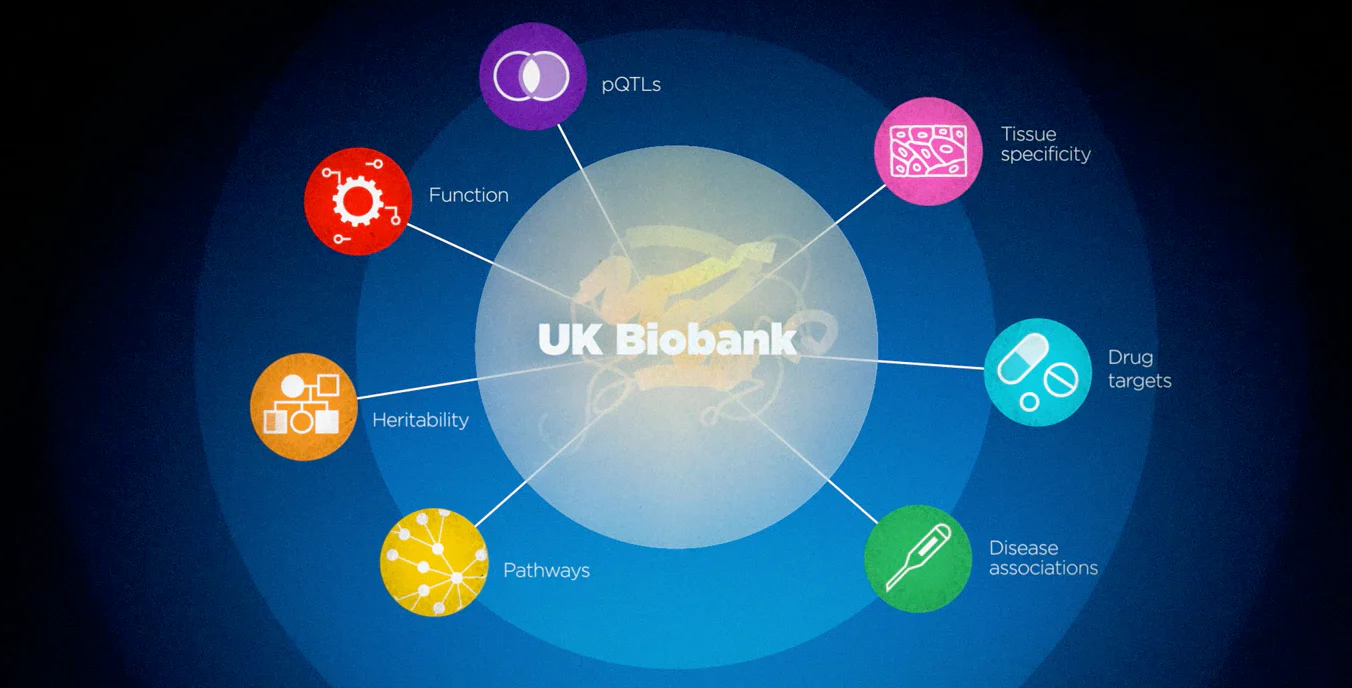
    UK Biobank Pharma Proteomics Project (UKB-PPP), 13 biopharmaceutical companies used Olink Explore 3072 to measure >3,000 proteins in over 54,000 samples from UKB participants, resulting in many hundreds of published articles. Phase II of this project, using Olink Explore HT to measure >5,400 proteins in 600,000 samples is currently underway.Learn more about the UK Biobank Pharma Proteomics Project.

    Question 12
    How does Olink proteomics differ from aptamer-based proteomics?

    Olink panels use antibody-based detection (PEA technology), while some other affinity-based proteomics platforms like SomaLogic use an aptamer-based detection.

    Both platforms support high-throughput proteomics, but they differ in their underlying chemistry and assay design. With dual antibody recognition technology, Olink proteomics is often selected when higher specificity is critical.

    Question 13
    How does Olink PEA differ from mass spectrometry-based proteomics?

    Olink proteomics is typically preferred for targeted, high-throughput protein measurement, particularly in large cohort studies.

    Therefore, mass spectrometry is often used for broader, untargeted proteomics exploration. While it can provide wider protein coverage, Olink proteomics offers higher sensitivity for low-abundance proteins and simpler workflows for large-scale studies.

    Question 14
    How does Olink proteomics differ from ELISA?

    Olink proteomics is designed for multiplexed protein analysis, while ELISA is typically used for single-protein measurement.

    Thus, Olink proteomics is preferred when multiple proteins need to be measured simultaneously, sample volume is limited, or large cohorts are analyzed. ELISA is often used when absolute quantification of a single protein is required.

    The table below summarizes the key differences between Olink PEA and other commonly used proteomics approaches.

    Olink PEA technology

    Aptamer-based proteomics

    Mass spectrometry-based proteomics

    ELISA

    Detection approach

    Dual-antibody recognition with DNA-based signal generation

    Aptamer-based affinity detection

    Mass spectrometry-based protein analysis

    Antibody-based assay, typically measuring individual proteins

    Typical research role

    Multiplex, high-throughput protein measurement

    High-throughput proteomics

    Broader, often untargeted proteomics exploration

    Targeted protein measurement

    Key distinction

    Uses Proximity Extension Assay technology with qPCR- or NGS-based readout

    Uses a different recognition reagent, chemistry and assay design

    Different analytical approach; can be complementary to PEA

    Typically lower multiplexing and often used when  absolute quantification of a specific protein is required

    Question 15
    What is NPX and is the data accepted by journals and peer reviewers?

    NPX, Normalized Protein eXpression, is Olink’s arbitrary unit which is in Log2 scale. It is calculated from Ct values and counts.

    Yes. Olink data has been used in over 4,000 peer-reviewed publications (many in the top-ranked scientific journals), and NPX is a well-understood output format in the proteomics community.

    Reviewers familiar with the field recognize PEA-based data as methodologically sound. For studies where absolute quantification is required, this should be discussed with the journal prior to submission — but for relative comparison studies, NPX is well established. In addition, Olink now offers several smaller panels that can provide absolute quantification.

    Question 16
    How is cross-site reproducibility managed with Olink proteomics?

    Cross-site reproducibility is one of the core engineering priorities of the Olink platform.

    Batch bridging protocols, built-in QC controls, and the dual-antibody PEA design all work together to minimize site-to-site variability. The Olink Concordance Test is specifically designed to verify that a lab’s data meets Olink-approved quality standards before a study begins.

    Question 17
    Which Olink options are suitable for smaller studies?

    The right panel depends on your study scope — and the Olink portfolio offers options across a wide range of scales.

    For cohorts where samples are limited or irreplaceable, the specificity advantage of PEA has a clear ROI: a single failed ELISA validation run can cost more than an Olink Target panel upfront. Olink Flex (5–30 proteins) and Target panels offer cost-efficient entry points for smaller studies, while Explore and Reveal are built for population-scale research.

    Question 18
    What data analysis and bioinformatics support is available for Olink studies?

    Olink proteomics provides bioinformatics support tools designed to carry your study from data generation through to interpretation.

    These include Olink Insight (free online bioinformatics app), Olink Analyze (data visualization), and the NPX Software suite. The Concordance Test enables ongoing data quality verification throughout a study.

    Key takeaway

    Olink proteomics is a high-throughput proteomics platform designed for biomarker discovery and large-scale studies that is also fully scalable down to more targeted investigations. Its PEA technology enables sensitive, multiplex protein measurement, making it particularly valuable in research requiring reproducibility, scalability, and efficient use of sample material.

    Whether you’re entering proteomics for the first time or scaling up a multi-site cohort study, Olink solutions offer clinical research findings, publication-ready pathway from discovery to clinical evidence.

    Citations

    Koprulu et al. (2026), Cell: This huge, multi-cohort proteogenomic analyses revealed genetic effects across the proteome and chronic disease spectrum, based on data from 78,664 participants across 38 studies, including 37 cohorts in the SACALLOP consortium, UKB-PPP, and the China Kadoorie Biobank (CKB).

    Argentieri et al. (2024), Nature Medicine: This meta-analysis of data from UKB-PPP, CKB and the FinnGen stud identified protein-based biological aging clocks with significant associations with 18 major chronic diseases.